
Corridors and fields do not fail suddenly. They close in a foot a year until the day a service truck cannot get down the easement or a fence line has disappeared into the tree line entirely. Eastern Land Solutions provides bush hogging services and right-of-way maintenance throughout Spartanburg, SC and the surrounding Upstate — utility and sewer easements, fence lines, ditch banks, farm and logging roads, pasture perimeters, and fields that need knocking down on a schedule. Regular cutting is a fraction of the cost of reclamation, and that is the whole argument for it. Call (864) 999-3420.
Maintenance work is matched to what has grown, and getting that match right is most of the value. Light annual regrowth — grass, briar, seedlings under an inch — is rotary cutting work: a bush hog behind a tractor or on a carrier, running the corridor and knocking everything down to a uniform height in a single pass. It is fast, it is cheap per foot, and it is the right tool as long as the interval has been kept. Two or three years of neglect changes the answer. Stems get thick enough to damage a rotary cutter and tough enough to spring back rather than shatter, and the work shifts to mulching with a drum head that can actually process the material — see forestry mowing for that side of it. Five or more years and it stops being maintenance at all and becomes clearing, at several times the price. Whatever the method, the work is defined by the same constraints: the easement width is a hard boundary, the corridor has to be passable end to end when we leave, and the cut material has to end up somewhere sensible. On corridor and fence line work it almost always stays where it falls, which is both cheapest and best for the ground — a bare linear strip on Piedmont clay running downhill erodes readily, and leaving cut material in place is the simplest protection there is. Sight lines, gate access, and truck clearance are the practical tests of whether the job was done right, not how tidy it looks from the road.
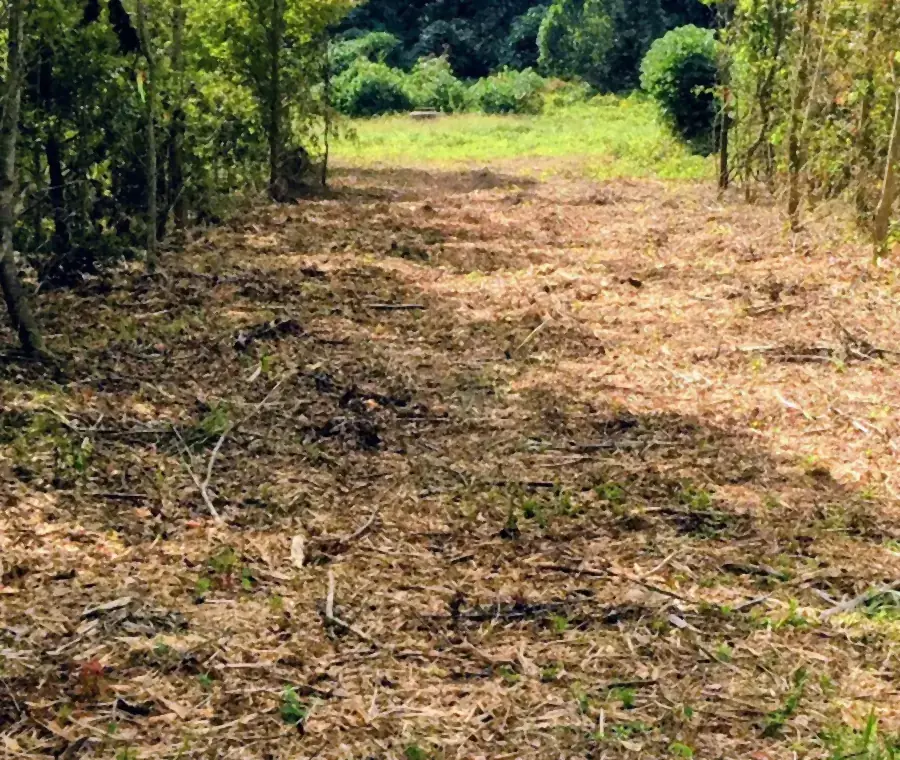
We walk or drive the corridor and assess what is actually growing, because quoting rotary cutting on ground that needs mulching is how a job goes wrong for both of us. We check the width against the easement, look for anything hidden in the growth — old fence, culvert ends, markers, stobs — and set the price against the real condition.
When growth has outgrown a cutter, see our forestry mulching services.
The easement width or the field boundary gets confirmed before cutting starts. We mark what stays and identify what a rotary cutter must not find: survey markers, riser pipes, valve boxes, guy anchors, and the rock that turns up shallow across much of this county. On corridors with buried infrastructure, we confirm depths and locations before anything mechanical touches ground.
The operator runs the corridor in overlapping passes at a controlled height, working the full easement width rather than a comfortable center strip. On fence lines we cut tight enough that the fence is inspectable and clear enough that it stays hot. Overhanging limbs from outside the easement get trimmed back to the line rather than removed.
Cut material stays in place on most corridor work, which costs less and holds the soil. Where it has to leave, we chip or haul it. Burning is possible in unincorporated areas but only after notifying the Forestry Commission, and burn bans go up with little notice, so we do not build schedules around it. On slopes we leave enough cover to prevent the corridor becoming a channel, consistent with the practices in Clemson Extension’s erosion and sediment control program.
We make sure the corridor is passable end to end for whatever has to travel it, then tell you honestly when it will need attention again based on what we just cut and how fast it was growing. Most Upstate corridors run one to three years between passes. Booking the next one keeps you in maintenance pricing instead of reclamation pricing.
We handle recurring cutting throughout Spartanburg County — Cross Anchor, Enoree, Pauline, Glenn Springs, Woodruff, Switzer, Pacolet, and Cowpens, along the US-176, SC-215, and US-221 corridors — and out through Reidville, Duncan, Wellford, and Lyman. We also cover Greenville County toward Easley, Cherokee County around Gaffney, and Laurens County. Working farms make up a large share of this: fence lines that have absorbed three feet of pasture on each side, field edges closing in, and farm roads narrowing until a hay trailer will not fit. The Upstate climate is why this is recurring rather than one-and-done. Long growing seasons, heavy summer rain, and a seed bank full of privet, kudzu, sweetgum, and wild rose mean a cut corridor starts closing the same season.
Family-owned and four people deep: Michael, his son Marshall, and two crew members who have been with the family for over thirty years and more than a decade. Recurring work depends on reliability more than anything else — showing up on the interval, cutting the full width every time, and telling you the truth about when it needs doing again rather than selling a pass it does not need. Meet the crew that will be running your corridor. Because we also clear, mulch, and excavate, a corridor that has gotten past cutting does not need a different contractor, and a wet crossing that needs a culvert does not stall the job. Tell us how long it has been since it was cut or call (864) 999-3420. Free estimates, credit cards accepted, Monday through Friday, 7:00 a.m. to 5:30 p.m., and see our other land clearing and site work across the Upstate.
Most Upstate corridors and fields need a pass every one to three years. Sunny corridors and bottomland crossings grow back fastest; shaded ground under a closed canopy goes longer. Fields being kept for hay or grazing are on their own schedule entirely. Setting a regular interval is dramatically cheaper over a decade than letting it go and paying to reclaim it.
A bush hog is a rotary cutter that knocks growth down and leaves it lying in pieces — fast and inexpensive on grass, briar, and small stems. A mulching head grinds material into chips and handles stems a rotary cutter cannot touch. Which one your job needs comes down to how long it has been since the last cut. We will tell you at the estimate, and we would rather quote the cheaper one where it will actually work.
Yes, and this is where knowing the ground matters. We identify survey markers, riser pipes, valve boxes, guy anchors, and old fence remnants before cutting, because a rotary cutter finding any of those is expensive for everyone. Point out anything you know about at the walkthrough — buried and half-grown-over items are the ones that cause trouble.
That is the intent of this work, and it prices better than call-by-call reclamation.