
Before a sewer main, a water line, or a power run can go in, somebody has to cut the corridor it travels through — to the right width, inside the easement, and finished well enough that the installation crew can actually work in it. Eastern Land Solutions provides right of way clearing services throughout Spartanburg, SC and the surrounding Upstate for new sewer and water corridors, utility and power runs, pipeline strips, and new access roads. This is work Michael has done for years, including new sewer right-of-way, and it is a different job from clearing a tract. Call (864) 999-3420 and we will come look at the route.
Corridor clearing is linear work measured in feet of length and width, and the boundaries are legal rather than aesthetic. The easement document defines the width; cutting outside it is a real problem, and cutting short of it means the installation crew cannot work and somebody has to come back. So the job begins with the survey — centerline located, offsets established, and the limits flagged so the operator has a hard edge to work to. Then access, which on a new corridor is usually the hardest constraint, because by definition there is no lane in yet and the route may cross ground the equipment cannot easily reach. From there the clearing runs like a narrow, precise version of a tract clearing. Standing timber comes down with a saw crew and a tracked excavator with a grapple, felled toward the corridor so nothing lands outside the easement. Merchantable stems get sorted and decked where volume justifies it. Where the trench or line is going, the ground gets grubbed — stumps and root plates out, not cut off, because a trencher or an excavator working a line through a field of root wads is slow and expensive, and buried wood under a backfilled corridor settles. Debris gets mulched in place, chipped, hauled in dump trucks, or burned after notification. The last phase is what separates a corridor from a cleared strip: it gets graded to a stable working platform, wide enough and level enough for the installation equipment to travel and set pipe, with drainage handled so the corridor is not a channel. Wet crossings get planned rather than driven through, and slopes get stabilized before the first storm turns a bare linear strip into a gully.
Where corridor material is best processed in place, see our forestry mulching services.
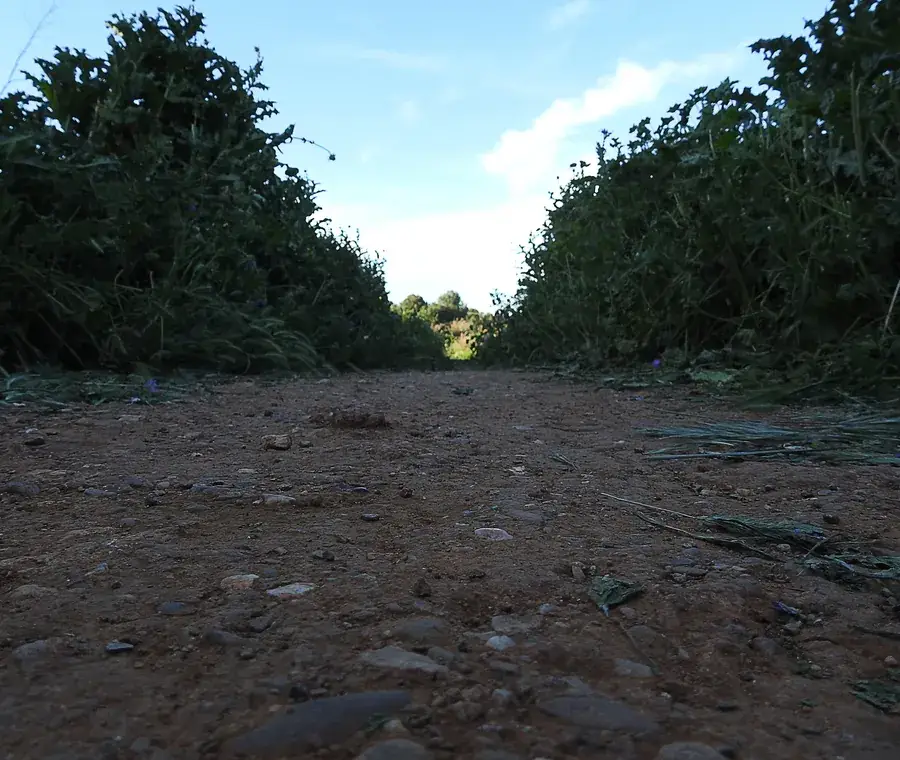
We start with the recorded easement and the surveyor’s stakes: centerline, width, and any restrictions written into the document. We walk the route end to end before quoting, because a corridor that averages easy can contain two hundred feet that dictates the whole price — a creek crossing, a rock outcrop, a stand of mature hardwood.
We identify where equipment enters without crossing ground it should not, coordinate with adjacent landowners where crossing is unavoidable, and plan direction of travel so the machine is not backing long distances. Anything being dug gets a ticket with SC811 and the required three full business days, and existing infrastructure inside or crossing the corridor gets identified before a machine moves.
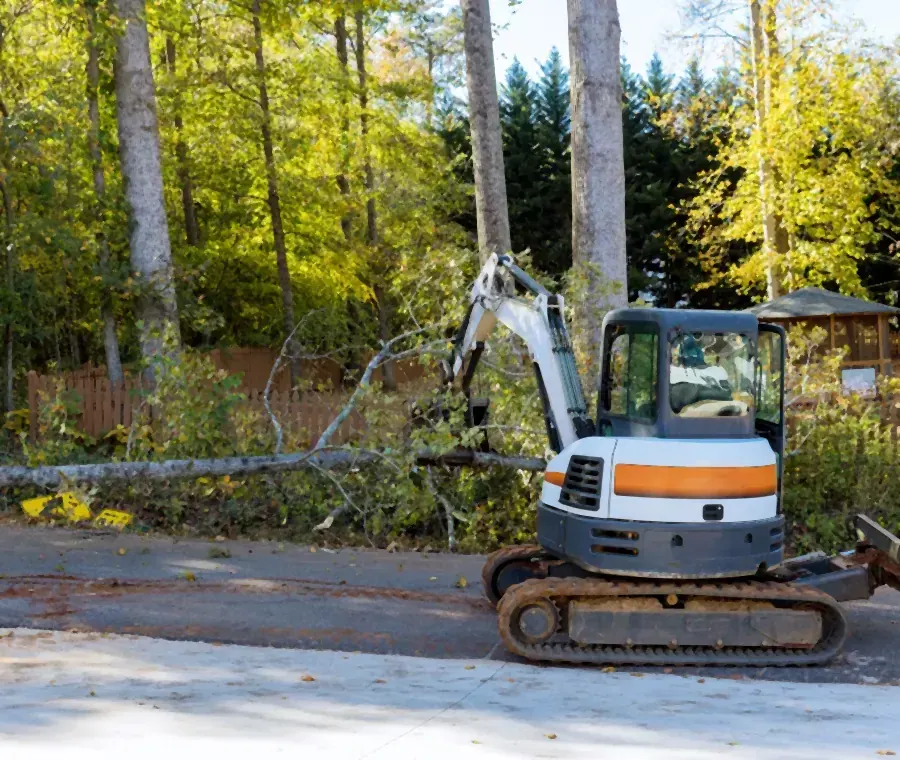
Timber comes down felled into the corridor. Stems get sorted and decked where there is volume worth keeping. Where the trench or line will run, we grub the root mass out rather than cutting it off, so the installation crew is working in clean ground.
Debris gets mulched in place where that works, chipped, or hauled in our trucks. Where burning is the right call, it happens only after notification to the Forestry Commission — state law specifically names vegetative material from land clearing and right-of-way work. Cut slopes and bare stretches get stabilized as we go, following the erosion and sediment control practices taught through Clemson Extension’s state certification program.
The corridor gets graded to a travelable, workable platform at the specified width, with drainage shaped so water crosses it rather than running down it. What the installation contractor inherits is a corridor they can put equipment in on day one instead of spending their first week fixing ours.
We cut new corridor throughout Spartanburg County — Wellford, Lyman, Startex, Duncan, Reidville, Woodruff, and Roebuck — and along the I-85 corridor through Greer toward the Inland Port, where utility extensions have followed industrial and residential growth steadily for years. We also work Greenville County to Easley, Cherokee County around Gaffney, and Laurens County to the south. Corridors in this region routinely cross the Tyger and Enoree drainages and their tributaries, and those bottomland crossings are where planning matters most: they stay wet late into the year, and a corridor driven through one at the wrong time creates damage that costs more to repair than the crossing did to clear. Once the corridor is in service, keeping it open is right-of-way maintenance and should be scheduled rather than deferred.
Right-of-way work rewards experience more than equipment. Michael has decades of corridor work behind him, including new sewer right-of-way, and this is a four-person family crew with consistent faces and one point of contact. The practical advantage on a corridor is that we cover the whole scope: clearing, mulching, tree work, grubbing, grading, and excavation are the same crew and the same mobilization. Most corridor projects turn into more than one kind of work — a stretch that needs mulching, a section of timber that has to come down, a wet crossing needing a culvert, a length that has to be graded for a trencher — and we are not coordinating three subcontractors’ calendars to get it done. Send us the corridor length and width and how far it runs, or call (864) 999-3420. Free estimates, credit cards accepted, Monday through Friday, 7:00 a.m. to 5:30 p.m. See clearing and site work across the Upstate.
By length and width, adjusted for the density and size of what is standing in the route, the terrain, the number of crossings, and what happens to the debris. Because corridors are linear, one difficult section can drive the price of the whole run, which is why we walk the route rather than quoting off a map.
Just where it needs to be grubbed, usually the trench line and any area the installation equipment has to work from. Grubbing the full easement width when only a portion needs it is wasted money and unnecessary soil disturbance. We scope it against what the installing contractor actually needs.
We work in and along corridors containing live infrastructure, and everything dug gets located first. Work in direct proximity to energized overhead conductors is specialized — depending on voltage and clearance it may require a line-clearance qualified crew, and we will tell you plainly if a section falls into that category rather than taking a risk with it.
Typically the party doing the land disturbance, and on a permitted project it will be spelled out in the plan. Either way we install and maintain controls as part of the work, because a bare linear strip on Piedmont clay running downhill is the most reliable erosion channel you can build.