
Almost every drainage complaint in the Upstate traces back to a grade that was never set right in the first place. Water standing against a foundation off Anderson Mill Road. A back yard in Moore that has been a bog since the house was built. A shed pad that racked because the ground under it moved. Eastern Land Solutions provides site preparation services across Spartanburg, SC and the surrounding Upstate — reshaping ground so it drains on purpose instead of by accident and carries load without moving. Call (864) 999-3420 for a free on-site estimate.
Site prep is the work between a cleared piece of ground and something you can build on. It looks simple from the road and it is not. These are the three jobs we are called for most:
Land grading and leveling — cut and fill to reshape a site, correct drainage, and level ground that has never been level. Land grading and leveling
Building pad preparation — compacted pads for houses, shops, pole barns, sheds, and slabs, built up above the surrounding grade and shaped to shed water. Building pad preparation
Driveway grading and drainage — regrading rutted and washboarded drives, setting crown and fall, and putting culverts and ditches where the water actually needs them. Driveway grading and drainage
The common thread is compaction. Material moves from cut to fill in lifts, each one compacted before the next goes down, because fill placed in one deep layer never reaches uniform density and settles unevenly under whatever gets built on it. Topsoil comes off first and gets stockpiled — organic material will not compact and cannot be built on. Soft or saturated subgrade gets undercut and replaced with stone. Where the site has to be dug rather than shaped, excavation comes first and usually in the same visit.
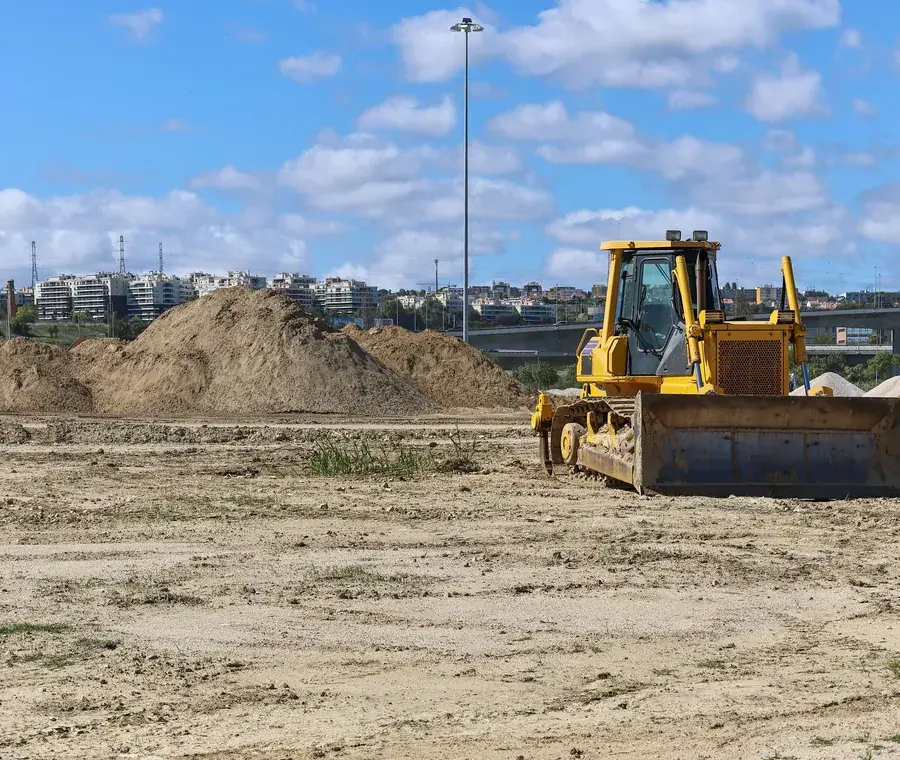
We grade and prep sites throughout Spartanburg County — Roebuck, Moore, Una, Switzer, Arkwright, Pauline, White Stone, Woodruff, Reidville, and the neighborhoods along US-221 and SC-296 — and north and west through Boiling Springs, Inman, Lyman, Duncan, Startex, and Greer. We also work Greenville County out toward Easley, Gaffney and the Cherokee County line, and Laurens County to the south. None of this country is naturally flat. Upstate lots roll, and the difference between a buildable homesite and an expensive one is usually cut-and-fill volume that is not obvious until somebody shoots the grades. Add red clay that holds water at the surface and drainage becomes the defining problem on most sites we look at. See the full range of land services we offer — most grading jobs end up bundled with clearing or excavation anyway.
This is a four-person, family-owned operation. Small crews are an advantage on grading specifically, because the person who read the site is the person moving the dirt — nothing gets lost between the estimate and the machine. Michael brings twenty-five years of running heavy equipment across this region, and grading rewards that time more than almost any other dirt trade: knowing how much a clay fill will settle, reading where water will sit before it ever rains, and knowing when to stop and let a site dry rather than churning it into something unusable. More about the family that runs the equipment.
We keep the compliance side visible too. Land disturbance of an acre or more requires stormwater permit coverage before work begins, with a simplified pollution prevention plan between one and two acres and a comprehensive plan prepared by a licensed professional above that — the thresholds are published by SCDES, and the erosion and sediment control practices we use on site follow the standards taught through Clemson Extension’s CEPSCI program. Free estimates, credit cards accepted, Monday through Friday, 7:00 a.m. to 5:30 p.m. Tell us what you are building or call (864) 999-3420.
Usually, and it is the right fix far more often than a drainage product is. Most standing water in Upstate yards is a grade problem — not enough fall away from the structure, a low spot with nowhere to drain, or uphill runoff funneled somewhere it was never meant to go. We will tell you honestly if the problem is bigger than grading.
It depends on how much you are disturbing. Under an acre in a non-coastal county generally requires a notification form; one to two acres requires permit coverage with a simplified SWPPP; over two acres requires a comprehensive plan prepared by a licensed engineer, landscape architect, or Tier B land surveyor. Your county or city may add requirements.
Late spring through early fall is generally the most workable window, because clay needs to be near the right moisture content to compact properly. Winter work is possible but slower, and a wet stretch can shut a site down entirely.