
You want your woods back, not a bare field. Eastern Land Solutions provides underbrush mulching throughout Spartanburg, SC and the surrounding Upstate — clearing out the privet, briar, honeysuckle, and volunteer saplings choking the understory while leaving the canopy standing. One machine, one pass, everything ground into a mulch layer where it stood. No piles, no burning, no trucks hauling debris out to the road. It is the fastest way to turn a wooded lot near Glenn Springs or a hunting tract off Cross Anchor Road into ground you can actually walk, see through, and use. Call (864) 999-3420 and we will come look at it.
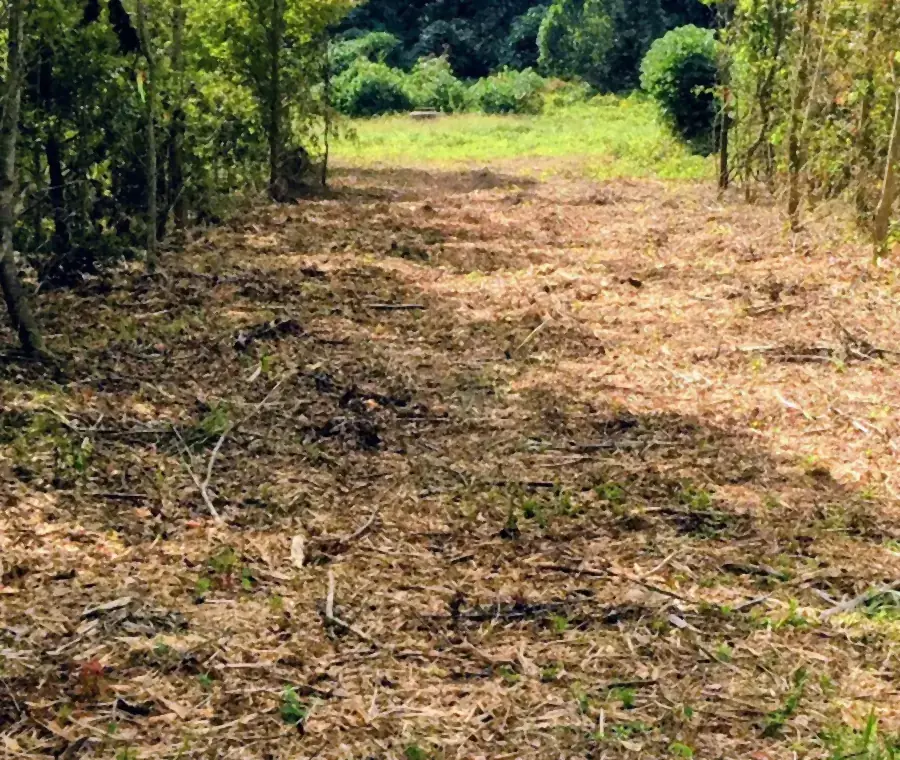
A tracked carrier fitted with a drum mulching head — a steel drum carrying rows of carbide-tipped teeth spinning at high speed — works through the understory, cutting stems off at ground level and running back over the downed material until it is reduced to a coarse mulch. The operator works selectively, taking out what is below the target size and leaving the trees you have marked to keep. That selectivity is the whole point and it is where the skill lives: it is easy to run a mulching head through a stand and come out the other side having scarred the trunks of every hardwood you meant to save. Bark damage at the base of a mature tree is a slow death sentence, and compaction over the root zone does the same thing more quietly. Clemson Extension notes that tree roots extend two to three times the width of the canopy, which is a much larger footprint than most people picture when they think about where a machine can safely travel. So we plan travel paths instead of wandering, keep the carrier out from under the drip line of the best trees where the site allows, and stay off saturated ground entirely — Piedmont clay holds compaction for years once equipment has worked it wet, as Clemson research on Piedmont forest soils documents. The mulch left behind is doing work, not sitting there as waste. Two to four inches holds the soil through the first storms, shades out the seed bank that would otherwise green back up in six weeks, and breaks down into organic matter over a season or two.
We go through the stand with you and agree on the keepers — the mast-producing oaks and hickories, the shade trees near the house, anything with a fence or a survey marker attached. We also agree on the target size: everything under four inches, everything under eight, or a specific species list. That conversation is what makes the finished job look like your woods rather than somebody’s clear-cut.
Anything too big for the head comes down first with a saw and gets laid where the mulcher can process it. This keeps the machine working at its efficient rate instead of grinding away at a stem it was never built for, and it shows up on your invoice as fewer hours on the ticket rather than as a heroic effort.
The operator works in overlapping passes, feeding material from the top down so stems go into the drum cleanly rather than getting pushed over and buried. Mulch depth is managed as we go — heavier on slopes where erosion is the concern, lighter where you want grass or native browse coming back through it quickly.
We make a finish pass to even the mulch layer and pick up anything the first pass rode over, then walk it with you. Most owners are surprised they can walk the property the same afternoon we finish, with no piles to dispose of and no burn notification to chase. If you would rather the material be removed and hauled off instead, that is a different service and we price it separately.
If the property needs the material removed rather than processed in place, see our land clearing services.
We mulch understory throughout Spartanburg County — Roebuck, Pauline, White Stone, Glenn Springs, Switzer, Woodruff, and Enoree — and out through Reidville, Duncan, and Greer, plus Boiling Springs and Inman to the north. We also work Greenville County west to Easley, Cherokee County around Gaffney, and Laurens County to the south. Hunting tracts, residential acreage backed up to woods, subdivision buffer strips, and family land that has not been walked in years are the typical jobs. Selective understory mulching is particularly valuable on hunting property: taking out the mid-story while leaving the canopy opens sight lines and stimulates browse at deer height without clear-cutting anything, and it does it in a day or two rather than a season. See the rest of our land clearing and site work across the Upstate if the tract needs more than the understory taken out.
Selective work is an operator skill, not an equipment spec. Two outfits with identical machines will hand you very different-looking woods. Michael has twenty-five years on heavy equipment across this region, and Eastern Land Solutions is a four-person family crew — him, his son Marshall, and two men who have worked with the family for over thirty years and more than a decade. The operator you are hiring is the person who quoted your job, which is why the conversation about what stays actually reaches the machine.
The other advantage is that mulching sidesteps the debris problem entirely. There is nothing to haul, nothing to pile, and nothing to burn — which matters more than it sounds, because South Carolina requires prior notification to the Forestry Commission before burning vegetative debris outside city limits, and statewide burn bans get declared during exactly the dry, windy stretches when most people want their property cleaned up. Free estimates, credit cards accepted, Monday through Friday, 7:00 a.m. to 5:30 p.m. Tell us about your woods or call (864) 999-3420.
It is priced by machine time. Stem density, average stem size, slope, how selective you want us to be, and how much oversized material has to be cut first are the drivers. Selective work around trees you are keeping is slower than open mulching and costs accordingly. It is still generally cheaper than clearing the same ground, because there is no grubbing, loading, or disposal.
Brush, briar, vines, saplings, and stems up to roughly eight inches feed through cleanly. Bigger material can be taken but slows the machine enough that it is usually cheaper to drop it with a saw first.
Not if the job is done properly, and that is what you are paying for. The two risks are bark damage at the base and compaction over the root zone. We keep the carrier out from under the drip line of your best trees where the ground allows, plan travel paths, and stay off wet ground. If you are keeping trees you particularly care about, tell us at the walk-through — and if you are planning to add trees afterward, Clemson’s guidance on tree selection is worth reading first.
One to three years for most tracts, depending on sun exposure and what was growing there. Species with established root systems — privet, kudzu, briar — push back sooner because the roots survive underneath the mulch. A maintenance pass costs a fraction of the first job, so most owners set an interval rather than waiting for it to close up completely.
It depends on depth. A heavy layer suppresses everything, which is what you want for erosion control on a slope. If you intend to seed a food plot or establish grass, tell us at the estimate and we will run a lighter layer over those areas so seed can reach soil.