A slab is only as good as the pad under it, and a pad is invisible the moment concrete covers it. That is why it is the easiest place on a job to save a few hundred dollars and the most expensive place to have done so. Eastern Land Solutions handles building pad preparation throughout Spartanburg, SC and the surrounding Upstate — house pads, shop and garage slabs, pole barns, equipment sheds, and storage buildings. We build them up, compact them in lifts, and shape them so water sheds off rather than sitting underneath. Call (864) 999-3420 and tell us what you are putting on it.
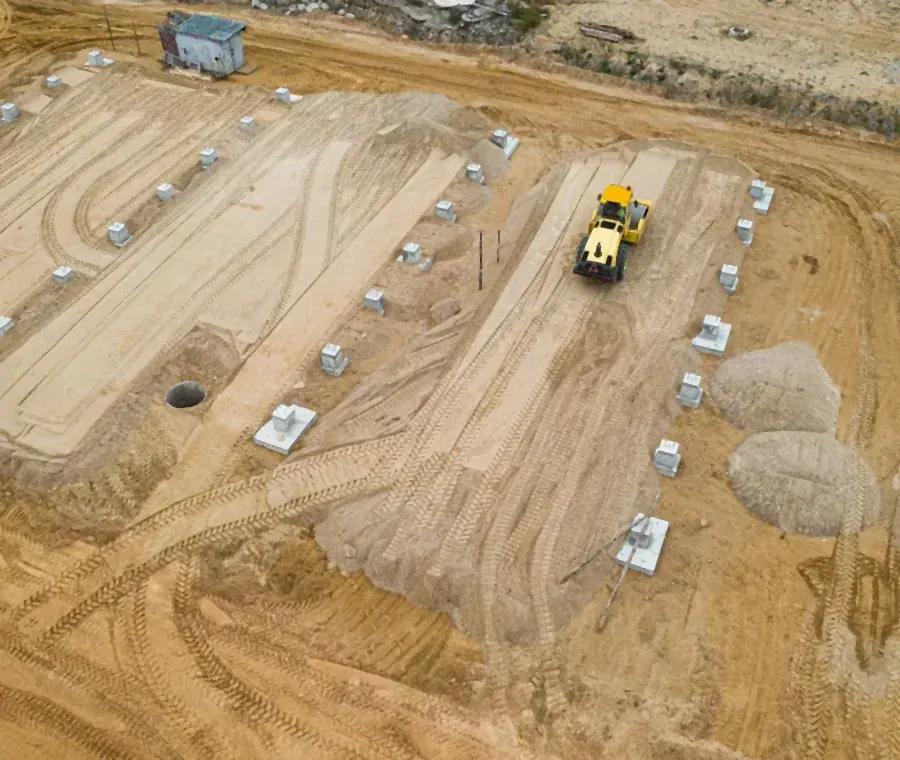
A building pad is a compacted platform built to a set elevation, sized larger than the structure itself, and shaped to shed water. The sequence matters more than the equipment. First the footprint is cleared and the topsoil stripped — all of it, plus any roots, stumps, or previously placed fill — because organic material will not compact and continues to decompose under load, which is how slabs end up with a settled corner. Then the exposed subgrade is examined and proof-rolled to find the soft spots. Anywhere it flexes or pumps gets undercut and replaced with stone. From there the pad is built up in lifts, each spread to a controlled thickness and compacted before the next goes on, because deep uncompacted fill never reaches uniform density and will settle unevenly no matter how good the concrete is. The pad is oversized past the building line on all sides — a pad cut exactly to the footprint leaves the slab edge sitting on the shoulder of the fill, which is the least stable part of it. The finished surface is brought to elevation and crowned or given a slight fall so runoff leaves rather than pooling at the base of the structure. On Piedmont clay this is genuinely favorable ground when it is handled right: Clemson’s published work shows how well these soils hold compaction once worked. Handled wrong — placed too wet, or placed over organics — it is the least forgiving material in the region.
For broader site shaping around the pad, see our land grading and leveling services.
A shed pad and a pole barn pad and a house pad are three different builds. We need the building dimensions, the intended finished floor elevation, and how the structure will be anchored or footed, because that drives the depth, the extent, and how much the pad has to be oversized. We stake the location, check the setbacks, and look at how equipment and later concrete trucks will get to it.
Everything organic comes off — topsoil, roots, stumps, and any soft fill a previous owner left behind. This is where corners get cut on cheap pads, and it is the single biggest predictor of whether a slab cracks in an unusual place five years later. Locate tickets go in for anything being dug, and sediment control goes in before the ground is opened.
We run a loaded machine over the exposed subgrade and watch it. Anywhere it flexes, ruts, or pumps water gets dug out deeper and replaced with compacted stone. It is a short step and it is the one that decides whether the pad is uniform, which matters far more than raw thickness.
Fill goes on in controlled lifts and is compacted before the next lift is placed, with moisture managed as we go. The pad is built past the building line on every side so the slab edge is not sitting on the fill shoulder. We bring it to the elevation your builder or the plan calls for, not to the elevation the ground happens to allow.
The surface is finish-graded, compacted, and shaped with fall so water sheds off it. Where stone is called for under the slab, it goes on and gets compacted as its own layer. What your concrete crew arrives to is a pad at the right elevation, uniformly compacted, dry, and reachable by a loaded truck.

We build pads throughout Spartanburg County — Woodruff, Enoree, Cross Anchor, Startex, Reidville, Roebuck, and Moore along the US-221 corridor — and north and west through Duncan, Lyman, Boiling Springs, Inman, and Greer. We also work Greenville County out toward Easley, Gaffney and Cherokee County, and Laurens County. Pole barns, equipment sheds, and shop buildings on rural acreage make up a large share of this work, and they have a specific failure mode in this region: a pad set flush with surrounding grade on clay that does not drain, so water runs in under the wall line every storm. Building the pad up and shaping the ground around it is what prevents it. If your project also needs footings dug, foundation excavation is handled by the same crew in the same mobilization.
Family-owned and small on purpose: Michael, his son Marshall, and two crew members with decades alongside the family. Twenty-five years on heavy equipment across the Upstate is mostly useful here as judgment — knowing when clay is too wet to place, what a subgrade is telling you when it flexes, and how much a fill will settle before you build on it. We would rather add a day and a load of stone than hand you a pad that looks right and is not. Where a site disturbs one to two acres, a simplified stormwater plan is required under SCDES rules, and we flag that at the estimate. Free estimates, credit cards accepted, Monday through Friday, 7:00 a.m. to 5:30 p.m. Send us the building size and the lot address or call (864) 999-3420, and see land and dirt work throughout the Upstate.
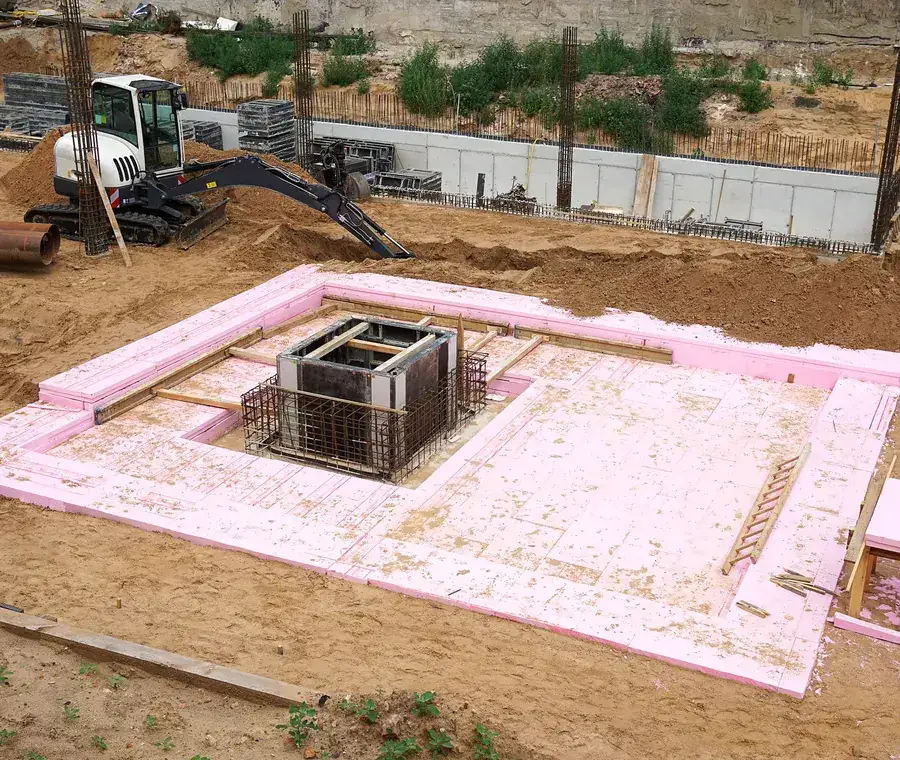
Wider than the footprint on every side, so the slab edge sits on well-compacted material rather than on the shoulder of the fill where density always drops off. How much wider depends on the height of the pad and the slope of its sides — a pad built up three feet needs considerably more shoulder than one built up six inches.
A pad built correctly in compacted lifts does not need a long settling period, because the compaction is doing what time would otherwise do badly and unevenly. A pad built by dumping fill and letting it sit is a different story, and no amount of waiting makes that fill uniform. Your builder or engineer may still specify a wait or a compaction test, and we will work to that.
Both, and small pads are a routine part of our week. A shed or pole barn pad is a smaller version of the same job — strip the organics, check the subgrade, build up in lifts, crown it, and make sure water is not running in under the wall line. The scale changes; the sequence does not.
Then the pad becomes a cut-and-fill exercise, and the cost is driven by the volume of material moved and whether it can be balanced on site. Sometimes moving the building thirty feet saves a substantial amount of dirt work. We will tell you at the estimate if that is the case rather than quietly quoting the expensive version.