
A driveway that fails did not fail at the surface. It failed underneath, usually because somebody spread stone directly on clay and topsoil and called it a base. Two winters later it is pumping mud through the gravel, the ruts have become a channel, and adding more stone just feeds the problem. Eastern Land Solutions handles driveway excavation and road work across Spartanburg, SC and the surrounding Upstate — new residential drives, long rural approaches, farm and field roads, and access lanes onto raw land. We cut it, undercut what will not carry, and build a base that holds. Call (864) 999-3420 for a free on-site look.
The work is building a structure that happens to be flat. It starts with the route, which on rural Upstate property is rarely a straight line — you are working with the slope, the drainage, the tree line, the sight distance at the road, and where the driveway can cross a wet-weather branch without becoming a dam. Then the cut. Topsoil and organic material come off the full width and get removed, because organics never compact and anything built on them will move. The exposed subgrade gets examined and proof-rolled; soft, springy, or saturated spots get undercut deeper and replaced with larger stone, sometimes over geotextile fabric where the clay is bad enough that stone would otherwise sink into it and disappear. That fabric is not an upsell in this region; on Piedmont clay it is often what determines whether the base you paid for is still there in five years. Then the base goes in — placed and compacted in lifts, crowned so water sheds to the sides rather than running down the middle, and tied into the ditches, swales, or culverts that carry water away from it. Grade matters as much as material: too flat and water sits, too steep and it scours, and a long approach on a rolling lot usually needs both cut and fill to arrive at something drivable in a loaded truck. Where the drive meets a public road, the entrance apron, sight lines, and any pipe under the entrance are their own small project with their own requirements.
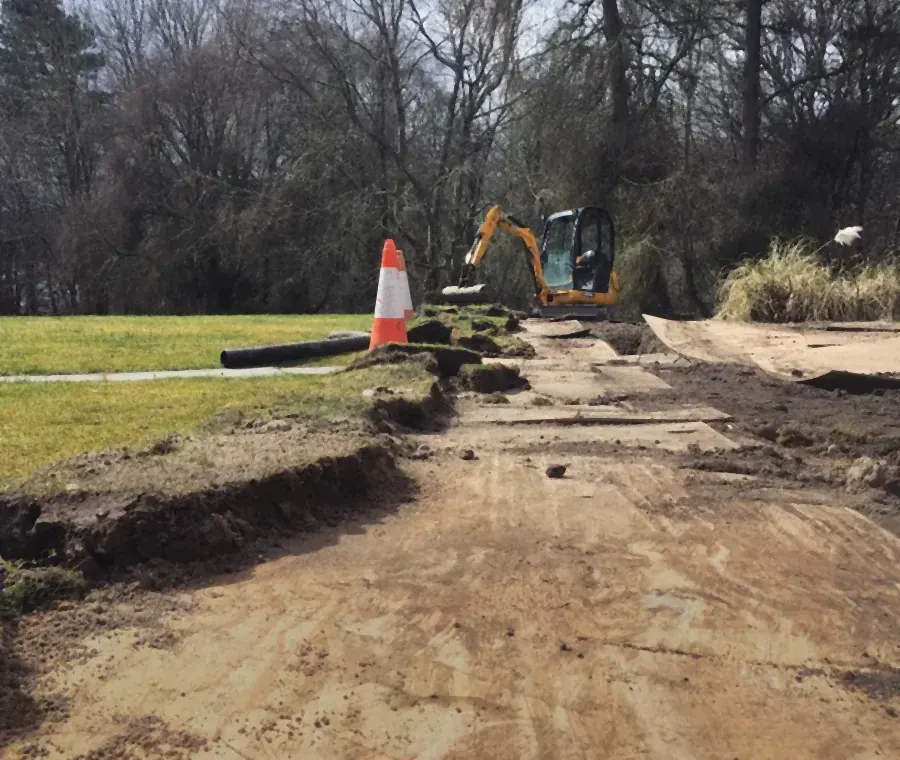
We walk the whole run with you, look at the grades, and figure out where water crosses or wants to. On a rural drive off SC-56 or a long approach through pasture, the route that looks obvious is often not the one that will drain. We set the width, the grade, and where any culverts have to go, then quote it in writing.
Anything standing in the way comes out including stumps, since a root plate under a driveway will rot and leave you a soft spot. Locate tickets go in with SC811 before we dig, because services, well lines, and septic laterals cross driveways constantly.
Topsoil and organics come off the full width and leave. We cut to the design grade, then look hard at the subgrade. Anywhere it flexes, pumps, or holds water gets dug deeper and replaced with larger stone, with fabric where the clay warrants it. Skipping this step is the single most common reason Upstate driveways fail.
Stone goes in in compacted lifts and the surface gets crowned to shed water. Ditches and swales are cut alongside, and culverts are sized and set at a slope that will actually move water and stay clear. Erosion control on the cut slopes goes in as we work, following the practices taught in Clemson Extension’s state erosion and sediment control program.
We finish-grade the surface, compact it, and drive it loaded to see how it behaves before we call it done. You get a driveway that carries a delivery truck and a concrete truck, sheds water instead of channeling it, and does not need a load of gravel dumped on it every spring.
For the grading and site-preparation phase after excavation, see our grading and site preparation services.
We build and cut drives throughout Spartanburg County — Pauline, Glenn Springs, White Stone, Cross Anchor, Woodruff, Roebuck, and Moore, including the long private approaches common on acreage over toward Croft State Park and along SC-56 — and north and west through Reidville, Duncan, Lyman, Boiling Springs, and Greer. We also cover Greenville County to Easley, Gaffney and Cherokee County, and Laurens County. Rural driveways in this region tend to be long, on rolling ground, crossing at least one drainage path, on clay that will not carry stone without help. That combination is the whole reason base preparation matters more here than a flatter, sandier part of the state.
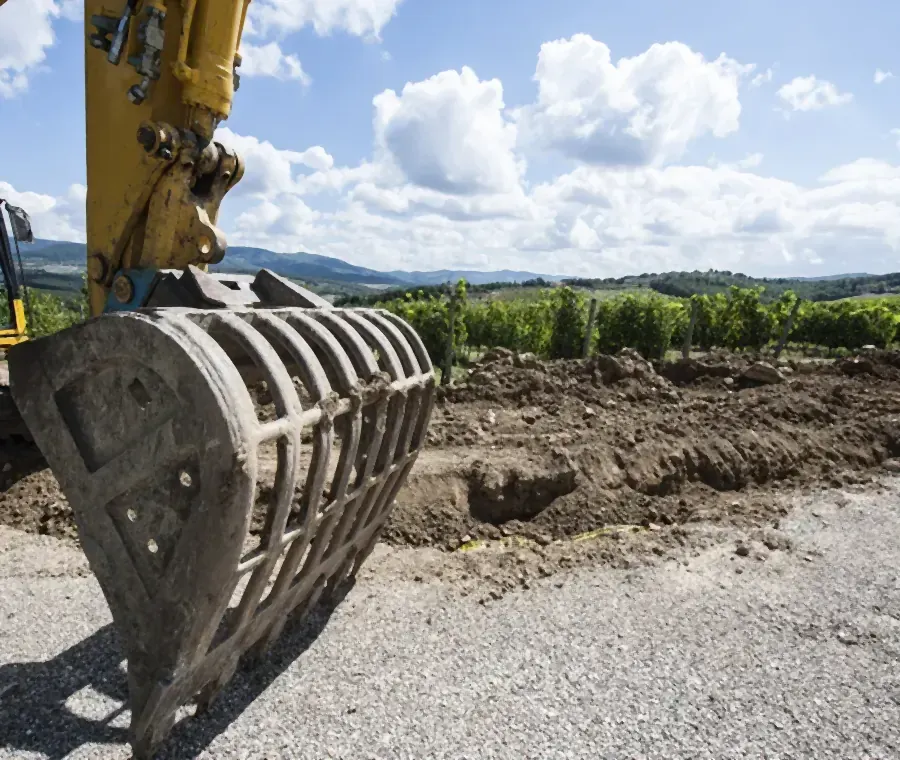
Family-owned and family-run: Michael, his son Marshall, and two crew members who have been with the family for decades. Because we also clear, grade, and excavate, a driveway job that turns into clearing a corridor or correcting a drainage problem does not require a second contractor and a second mobilization. The family that runs the equipment is on site, and the number you get at the estimate is the number the work is done for. Free estimates, credit cards accepted, Monday through Friday, 7:00 a.m. to 5:30 p.m. Tell us where the drive needs to go or call (864) 999-3420. If your existing drive needs reshaping rather than rebuilding, see driveway grading and drainage, and the full range of dirt work we do is on the homepage.
It depends entirely on the subgrade and the loads. A drive over firm subgrade needs less than one crossing soft clay, and a drive that will see concrete trucks and equipment needs more than one carrying two cars. The honest answer is that depth is set after we see what the subgrade does under a loaded machine, which is why proof-rolling is part of the job rather than an extra.
Almost always because stone was placed straight onto clay or topsoil without stripping and undercutting. The clay pumps up into the stone when it is wet, the stone disappears into it, and every fresh load of gravel does the same thing. Fixing it properly means cutting the failed section out, undercutting, and rebuilding the base — not adding more stone on top.
If the drive crosses any path water takes, yes. Sizing matters — an undersized pipe backs water up and eventually takes the driveway out with it. Where the drive meets a public road, the entrance and pipe may be subject to the road authority’s requirements.
Usually, but the route matters more than the machine. Steep approaches need grade managed so vehicles can climb it loaded and in ice, cut slopes stabilized so they do not slough, and drainage designed so the drive is not doubling as a creek. Sometimes the answer is a longer route at a gentler grade rather than the direct line, and we will tell you that at the estimate.