
Idle land in the Upstate goes back to woods on a schedule. Two years and you have briar. Five and you have sweetgum and pine whips through the whole field. Ten and the fence line has disappeared and the pasture your father grazed is timber. Eastern Land Solutions handles pasture reclamation and clearing land for farming throughout Spartanburg, SC and the surrounding counties — grown-up fields, fence lines, hay ground, hunting tracts, and acreage going back into production. We work with the way a farm actually operates, not the way a subdivision does. Call (864) 999-3420 for a free walk of your acreage.
Reclaiming farm ground is a different job from clearing a building lot, and the standard is different too. You are not preparing for a foundation; you are preparing for a bush hog, a hay mower, a drill, or livestock — which means the finish standard is measured by what will damage equipment and what will hurt an animal. The work starts with a walk to establish what the field is going to be used for, because that determines how clean the ground has to be. Hay ground has to be genuinely smooth and stump-free; rotational grazing tolerates more. Then the clearing itself: standing volunteer timber comes down, brush and briar get cut or mulched, and stumps come out where the ground will be mowed or worked. Stumps are the crux of a farm job. A stump left at four inches is invisible in June and catastrophic to a mower deck at hay time, so anything in equipment traffic gets grubbed or ground below the working depth. Fence lines get their own pass, since a fence buried in growth cannot be inspected, repaired, or kept hot. Debris usually stays on the farm — chipped, mulched, or burned after notification, since most farms have somewhere sensible to put it and hauling it off is money spent for nothing. The last step is stabilizing the surface so the first hard rain does not gully a field you just spent money on. What you get back is workable ground, visible boundaries, and a fence you can actually walk.
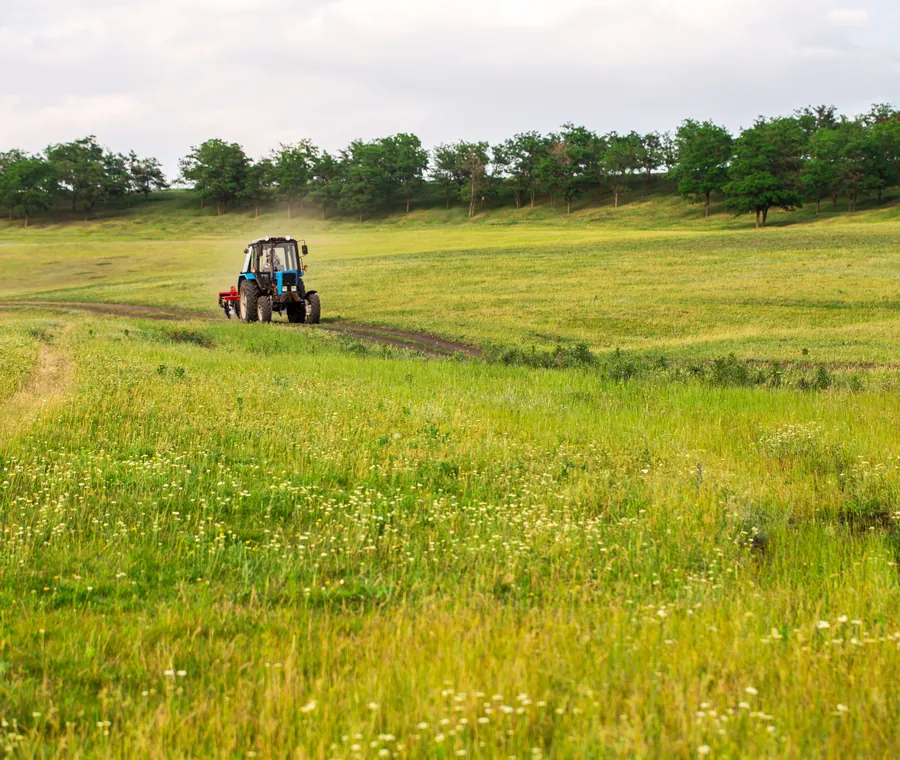
We ask what the field is going to do — hay, graze, row crop, wildlife, or just look maintained — because the answer changes the price substantially. Hay ground is the most demanding and costs the most; a wildlife opening is the least. We flag the field edges, decide how far into the tree line you want to reclaim, and identify the wet spots and drainages that should stay in trees rather than being opened up.
Volunteer timber and heavy brush come out of the field first. Then the edges, which is where most of the acreage has actually been lost — a field that looks like it shrank ten feet on every side has usually lost a quarter of its area over fifteen years. Reclaiming edges is the cheapest acreage on the farm to get back.
Anything in the path of a mower, drill, or hay equipment gets the root mass pulled, not shaved. This is non-negotiable on hay ground. Where a stump sits outside equipment traffic, grinding or mulching is enough, and we will tell you which pieces genuinely need the more expensive treatment rather than grubbing the whole field by default.
For acreage that needs ongoing vegetation control, see our forestry mowing services.
Material gets chipped, mulched in place, or piled and burned after notification — most farms prefer to keep it. Then we smooth the surface, fill the stump holes, and stabilize disturbed ground so a summer storm does not cut a gully through it. If your fence lines and farm roads need keeping open on a schedule after this, fence line and bush hogging maintenance is a fraction of the cost of doing this again in ten years.
We clear farm ground throughout southern and eastern Spartanburg County — Roebuck, Pauline, White Stone, Glenn Springs, Woodruff, Enoree, and Cross Anchor along SC-56 and US-221 — and south into Laurens County, where a lot of family land has come back onto the market. We also work Cherokee County around Gaffney, Greenville County out to Easley, and the northern side of the county through Inman and Boiling Springs. Bottomland along the Tyger and Enoree rivers is its own category of work: the soil is better, the growing is faster, and the ground stays wet longer, so those fields need different timing and often should not be cleared to the water’s edge at all. See everything we handle on the clearing, grading, and excavation side if the farm needs roads, drainage, or ponds as well as clearing.
We are a family-run outfit — Michael, his son Marshall, and two men who have been with the family for over thirty years and more than a decade — and farms tend to prefer that. You are dealing with the owner, the schedule can flex around hay cutting and calving, and nobody is going to show up with a crew that has never been on a farm. Michael has twenty-five years of running heavy equipment across this region, including the kind of large-volume clearing work where several hundred stems come out at once. A family operation that works with farms is not a marketing line here; it is just what this is.
Two practical notes on farm work. First, burning: most farms want to burn, and South Carolina allows it in unincorporated areas, but state law requires notification to the Forestry Commission before burning vegetative material from land clearing, and burn bans are declared during exactly the dry stretches when burning is easiest. Second, permitting: land-disturbing activity of an acre or more can require stormwater coverage through SCDES, though normal agricultural operations are treated differently from construction — we will tell you where your project falls at the estimate rather than guessing. Free estimates, credit cards accepted, Monday through Friday, 7:00 a.m. to 5:30 p.m. Tell us about your acreage or call (864) 999-3420.
The two biggest drivers are how far the field has gone and what standard you need it to. Reclaiming a field that has been idle three years is a mulching-and-mowing job. Reclaiming one that has fifteen years of pine on it is a clearing-and-grubbing job at several times the price. Hay ground costs more than grazing ground because the finish has to be smoother. We quote after walking it.
For hay ground, yes — a stump that is invisible in tall grass will destroy a mower deck. For grazing, it depends. Stumps ground flush are generally acceptable in pasture that will be bush hogged occasionally, and leaving root systems in place on slopes actually helps hold soil. We will tell you which parts of your field genuinely need the expensive treatment.
Not usually right away. Freshly cleared ground has disturbed soil, uneven surface, and no established root mass holding it. Most fields need smoothing, a stabilizing cover, and often a soil test and lime before they will carry a real stand. Your county Clemson Extension agent can advise on fertility — that side is outside our scope.
If the field is mostly brush and small stems and you mainly want it open and mowable, mulching is faster and considerably cheaper. If it has real timber on it, or the ground has to be smooth enough for hay equipment, clearing and grubbing is the right answer. Many farms do both — mulch the light acreage, clear and grub the ground going into production.
Yes, and for a lot of farms it is the highest-value work we do. A cleared fence line means a fence you can inspect, repair, and keep hot, and it recovers acreage that has quietly been absorbed into the tree line over the years. It is also fast, because a machine can run the line and process everything as it goes.