The tree you are worried about is usually the one that looks fine. A pine with a lean that has changed since the wet spring. An oak with a hollow at the base and a limb over the roof. A sweetgum that has been dropping deadwood into the driveway all summer. Eastern Land Solutions handles tree removal across Spartanburg, SC and the surrounding Upstate — hazardous trees near structures, storm-damaged trees, and volume removals on lots and acreage. Michael has spent twenty-five years taking trees off properties in this region, and it is the trade this family started in. Call (864) 999-3420 for a free estimate.
A removal is a controlled dismantling, not a felling contest, and the plan is decided before a saw runs. We assess species, height, lean, defects, the condition of the root plate, and what sits inside the drop zone. In open ground — a pasture, a cleared lot, a back field — the tree can be notched, back-cut, and laid down whole in a planned direction. That is fast and it is the least expensive version of the job. Near a house, a driveway, a service drop, or a fence, laying it down whole is not an option, so the tree comes down in sections instead: each piece cut and lowered or dropped into a controlled zone, working from the top, with the crew managing where every piece lands. That is slower, more technical, and priced accordingly, which is why the same tree can be two very different numbers depending on what is under it. Once the tree is down, the job becomes material handling. The crown goes through a chipper, the trunk is bucked into manageable lengths and either left stacked as firewood where you want it or loaded into a dump truck, and the site is raked and blown clean. The stump is a separate decision that should be made at the same time rather than later. Worth understanding about local trees: Clemson Extension notes that tree roots typically extend two to three times the width of the canopy, which is why root damage from construction or trenching shows up as a dead tree several years after the work that caused it.
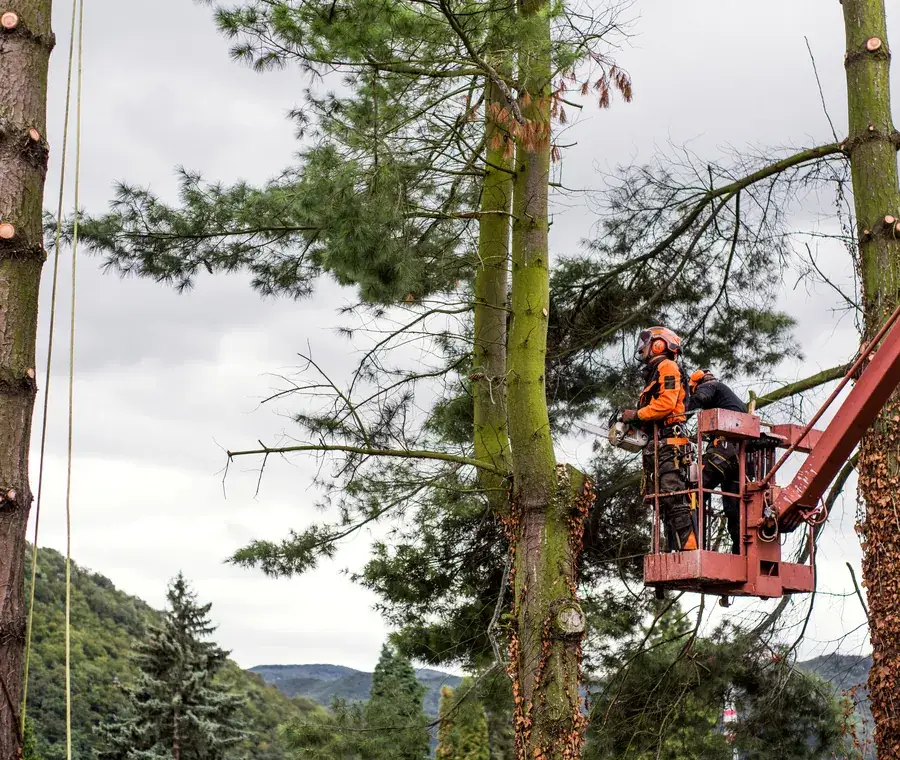
We come out and look. What is the tree, how tall, which way does it want to go, and what is underneath it? We check for the things that change the plan — a service drop through the canopy, a septic field in the drop zone, a neighbor’s fence four feet from the trunk, a root plate that has already lifted the soil on one side. Then you get a written number before anything is scheduled.
Before a saw runs we establish the drop zone, protect what needs protecting, and plan equipment access. Getting a machine into a back yard without tearing up the lawn is a skill of its own and it is the part of a tree job most homeowners judge us on afterward. Where ground is soft, we plan the travel path rather than trusting it.
Open-ground trees come down whole in a planned direction. Trees near structures come down in sections from the top, each piece controlled. Storm-damaged trees get treated differently again, because broken and uprooted wood holds tension that is not always visible and releasing it in the wrong order is how people get hurt.
The crown goes through our chippers — we run two high-capacity machines, which is why material leaves with us rather than sitting in piles for days. Trunk wood is bucked and either stacked where you want it or hauled off in our own dump trucks. We rake, blow the drive and walkways, and leave the property looking like we were not there, minus the tree.
A removal is not finished while the stump is still in the yard. We grind it or dig it out, backfill, and leave level, plantable ground — see stump grinding. Handling both in one trip costs less than bringing a second outfit back, which is the most common regret we hear from people who took the cheapest bid on the tree alone.
We remove trees throughout Spartanburg County — the established neighborhoods around downtown, Converse, Drayton, Saxon, Arcadia, and Fairforest, plus Roebuck, Moore, Una, Woodruff, and Reidville — and north through Boiling Springs, Inman, Lyman, Duncan, and Greer. We also cover Greenville County toward Easley, Gaffney and Cherokee County, and Laurens County. Local conditions create a specific set of problems here. Piedmont red clay is shallow and holds water at the surface, which encourages wide, plate-like root systems rather than deep anchoring, so a saturated spring followed by a hard wind takes down healthy-looking trees every year. Summer thunderstorms bring straight-line winds, and periodic ice storms load canopies past what pine and Bradford pear will carry. Older neighborhoods have the tallest, closest-planted hardwoods in the region, and those are the removals that require the most care.
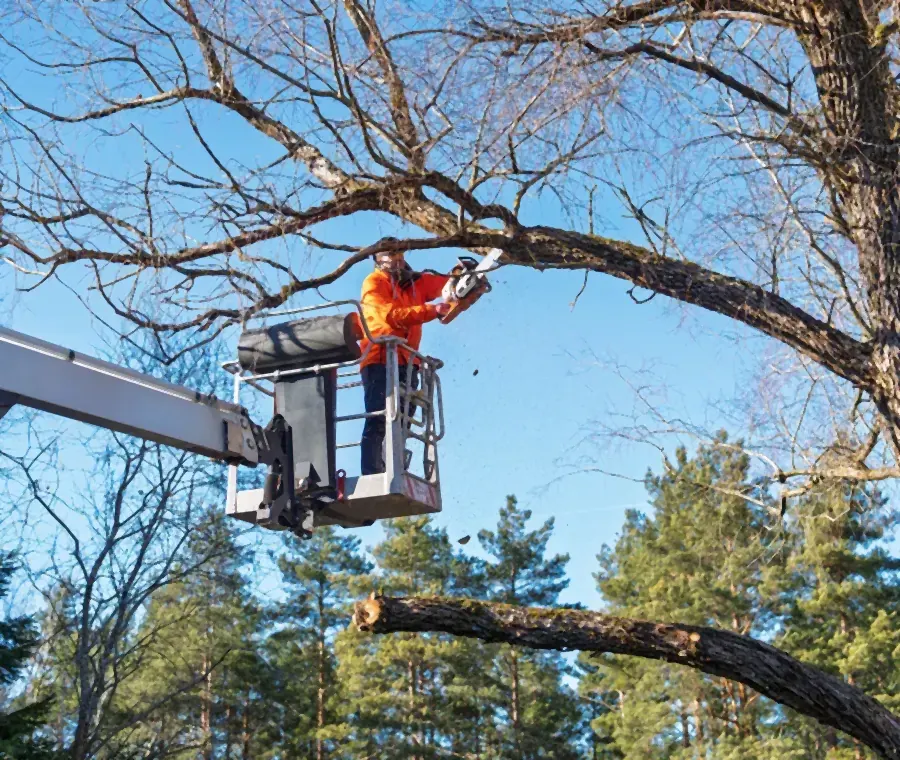
Tree work is this family’s original trade — twenty-five years of taking trees off properties across the Upstate, from residential yards to farms to golf course renovations where hundreds of stems came out at once. It is a four-person crew: Michael, his son Marshall, and two men who have worked alongside the family for over thirty years and more than a decade. Nobody is subcontracted, and the person who quoted your tree is on site while it comes down. Because we also clear, grade, and excavate, a tree job that turns into something larger does not mean starting over with a new contractor. If you would rather keep the wood and burn the debris yourself, note that South Carolina requires prior notification to the Forestry Commission outside city limits and burn bans go up quickly in dry stretches — most customers have us chip and haul instead. Send us a photo of the tree and your address or call (864) 999-3420. Free estimates, credit cards accepted, Monday through Friday, 7:00 a.m. to 5:30 p.m. See our land clearing, grading, and excavation work if the trees are one part of a bigger project.
For properties that need more than one tree removed, see our land clearing services.
Height, diameter, species, and above all what is underneath the tree. A pine in an open pasture that can be laid down in one piece is a fraction of the cost of the same pine standing eight feet off a roofline, because the second has to come down in controlled sections. Access for equipment, whether the wood is hauled or left, and whether the stump is included all move the number.
We quote it both ways so you can see the difference. Some customers want the trunk wood left and bucked for firewood, which reduces the price. Stump grinding or removal is a separate line item, but doing it during the same visit is always cheaper than a return trip.
Warning signs include large deadwood in the canopy, mushrooms or conks at the base, a hollow or cracked trunk, soil heaving on one side of the root plate, and a lean that has changed recently. Not every flawed tree needs removal — many can be pruned and monitored. For anything genuinely borderline near a house, a consulting arborist’s assessment is worth the money before you spend it on removal.
That is the work we are built for. Large-volume removals for site development, pasture reclamation, and lot preparation are handled as a clearing project rather than a tree-by-tree quote, which prices out significantly better per stem — see land clearing.