
The trees are fine. It is everything underneath them that has gotten out of hand — privet up to your shoulders, briar you cannot walk through, wild rose along the fence, and a layer of volunteer sweetgum that turned a nice piece of woods into somewhere nobody goes. Eastern Land Solutions handles underbrush removal and brush clearing throughout Spartanburg, SC and the surrounding Upstate. We take out the understory and leave the canopy, so you get your property back without clear-cutting anything. Call (864) 999-3420 for a free look at it.
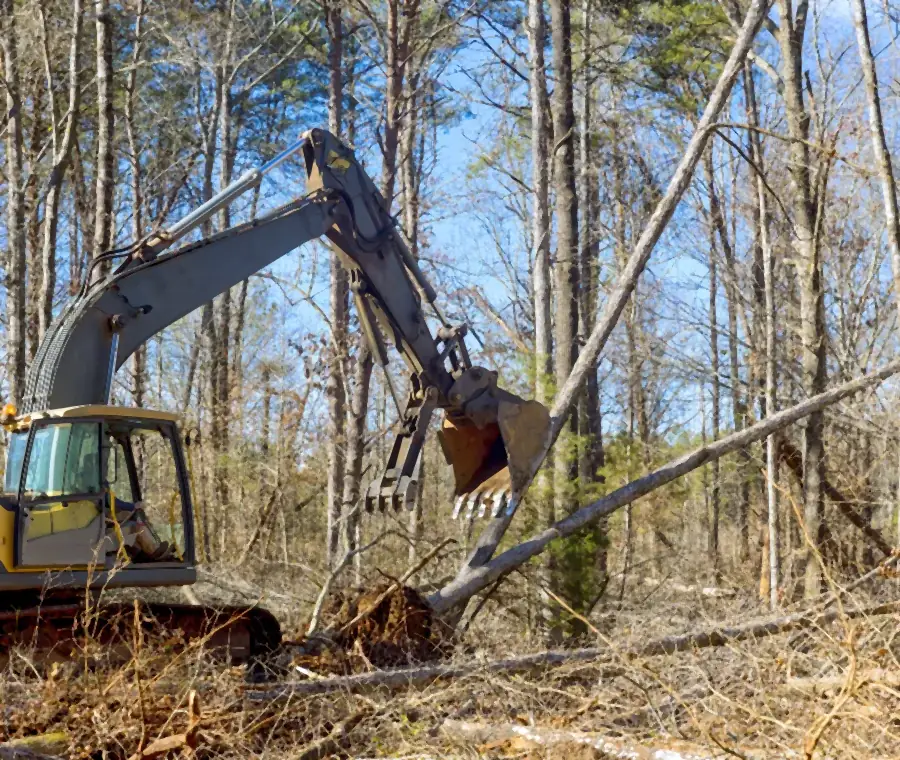
Underbrush removal is selective work: the goal is to take out everything below a certain size and leave the trees you want standing. That sounds simple until you are doing it around mature hardwoods you cannot damage. It starts with a walk-through where we agree on what stays — the shade trees, the mast producers, anything with a survey marker or a fence attached — and what the finished look should be. Then the method gets matched to the site. Light, open understory is often a cutting job. Dense growth with heavy stems and established root systems is better handled with a mulching head that processes material where it stands, or with an excavator and grapple where the material has to be pulled and stacked. Along fence lines, driveways, and property boundaries, hand crews with saws often do the finish work the machine cannot reach cleanly. The material either stays on site as mulch or gets chipped and hauled in our own trucks. What matters as much as the cutting is what happens to the ground. Piedmont soils compact hard under repeated equipment passes and Clemson research documents how long that compaction persists — so we plan travel paths rather than driving wherever is convenient, and we stay off saturated ground entirely. When it is done you can walk your woods, see your property lines, mow the edges, and use ground that has been unusable for years.
We walk it with you and mark it. This is the step people skip and regret. Selective clearing is only selective if both parties know what selective means — the trees worth keeping, the buffer along the neighbor’s line, the screen you want left for privacy, and the corners where you want a clean edge. Then we quote in writing.
Thin understory gets cut. Heavy tangle gets mulched in place. Material that has to be removed entirely gets pulled with the grapple and stacked for chipping. Most jobs use two of the three. If your goal is purely to open ground up and you do not mind mulch left on the surface, underbrush mulching is usually faster and less expensive, and we will say so.
The operator works around the trees you are keeping rather than through them. Bark damage at the base of a mature hardwood is a slow death sentence, and root zone compaction close to the trunk does the same thing more quietly. We keep equipment out from the drip line where the site allows it and take the tight work by hand.
Material is chipped, hauled, mulched, or burned after notification — your choice, priced at the estimate. Then we clean the edges: fence lines, driveways, and boundaries get a finished cut so the job looks intentional rather than abandoned halfway. We walk it with you before we load out.
For larger clearing work beyond brush removal, see our land clearing services.
We clear brush throughout Spartanburg County — Roebuck, Moore, Una, Arkwright, Fairforest, Arcadia, Pauline, and the older neighborhoods along the US-29 corridor south of the city, where deep residential lots back up to woods that have been left alone for decades. We also cover Woodruff, Reidville, Duncan, Boiling Springs, Inman, and Greer, plus Greenville County west to Easley, Gaffney to the northeast, and Laurens County to the south. What we are fighting here is consistent across the region: Chinese privet, kudzu, wild rose, blackberry briar, Japanese honeysuckle, and volunteer sweetgum and Bradford pear, all of which thrive in the Upstate’s long growing season and disturbed clay soils. See the rest of our land services across the Upstate if the brush is part of a bigger cleanup.
Brush clearing is the job most often done badly, because it is easy to do fast and hard to do carefully. Anyone can push a tangle over with a machine. Doing it without scarring the trees you are keeping, without compacting the root zones, and without leaving a debris field takes somebody who has been doing it long enough to know what the second-order damage looks like. Michael has twenty-five years on heavy equipment across this region, and we are a family crew, not a call center — the same four people every time.
We also own the disposal end of the job. Two high-capacity chippers and our own dump trucks mean the brush is gone when we leave rather than piled at the edge of your property waiting on somebody. If you would rather burn it yourself, note that South Carolina requires you to notify the Forestry Commission before burning outside city limits, and burn bans go up quickly in dry weather. Free estimates, credit cards accepted, Monday through Friday, 7:00 a.m. to 5:30 p.m. Tell us what you are dealing with or call (864) 999-3420.
Density is everything. An acre of light understory under an open canopy might be a few hours of work; an acre of solid privet and briar with eight-inch stems mixed in is a different job entirely. Access, slope, how selective you want us to be, and whether material is hauled or left all move the number. We price it after walking it.
Some of it, yes — privet, kudzu, briar, and honeysuckle all resprout from established root systems, and cutting alone does not kill them. Expect meaningful regrowth within one to three years depending on sun exposure. A maintenance pass on a regular interval costs a fraction of the first clearing, which is why we recommend setting a schedule rather than waiting until it is impassable again.
That is the entire point of doing it selectively, and it is what we plan the job around. The two risks are mechanical damage to the trunk and compaction over the root zone. We keep equipment out from under the canopy where the site allows, plan travel paths instead of wandering, and take tight work by hand.
Small stems are usually cut flush or mulched at ground level, which is fine for walking, mowing, and general use. If you need genuinely clean ground — for a fence line, a garden, or anything you will build on — the root systems have to come out, and that is a grubbing job we price separately.
Yes, and it is some of our most common work. Boundary strips, ditch banks, and fence lines are efficient to clear because a machine can travel a narrow lane and process as it goes. It is also the cheapest way to make a property feel maintained without clearing the interior.